Showing posts with label environmentalism. Show all posts

Monday, May 28, 2012

Zoos and Endangered Species -- trade-offs in everything

Take a look at this article by Leslie Kaufman for the New York Times, "Zoos’ Bitter Choice: To Save Some Species, Letting Others Die." An excerpt:
As the number of species at risk of extinction soars, zoos are increasingly being called upon to rescue and sustain animals, and not just for marquee breeds like pandas and rhinos but also for all manner of mammals, frogs, birds and insects whose populations are suddenly crashing.
To conserve animals effectively, however, zoo officials have concluded that they must winnow species in their care and devote more resources to a chosen few. The result is that zookeepers, usually animal lovers to the core, are increasingly being pressed into making cold calculations about which animals are the most crucial to save. Some days, the burden feels less like Noah building an ark and more like Schindler making a list.
A core dilemma is whether zoos should be more focused on entertainment, which people are more willing to pay for, or on preserving biological diversity for the "public good."

In some cases, it seems like advocates in the latter camp are more concerned with shaping public preferences than responding to them. The article continues:
Zoos are essentially given a menu of endangered species that the association is trying to maintain and can then choose according to their particular needs. But final decisions are often as much about heart as logic.
St. Louis, for example, has committed $20 million — or the equivalent of 40 percent of its annual operating budget — to building an enormous exhibit for polar bears — complete with a fake ice floe — even though its last polar bear died in 2009 and the Marine Mammal Protection Act makes it illegal to remove or rescue the bears from the wild. The zoo hopes that in the five years needed to open the exhibit, it can argue for an exemption, import orphaned bears from Canada or perhaps secure the cubs of captive bears.
Dr. Bonner acknowledges that the polar bear project runs counter to many of his more practical convictions on the role of the modern zoo. He has insisted that his keepers spend what limited field conservation dollars they raise on threatened animals that are most likely to make a comeback in the wild. With sea ice disappearing at an alarming rate, polar bears do not fit the profile.
But he justifies the exemption as a lesson for zoo visitors: “I want people to see this beautiful creature and ask, ‘How could we have let this happen?’ ”
Personally, if I went to a public zoo and saw nearly half of its operating budget spent on an object lesson in how difficult it is to preserve polar bears, collective guilt over habitat loss would not be the first thought to cross my mind.

There is a valid argument to be made for preserving biological diversity. Fear of a catastrophic breakdown, expressed through a variety of vivid analogies, is one of the more popular arguments, although perhaps one of the less valid. This "invisible threshold" argument has become a rationale for preserving species within even the most marginal ecological niches.
Several large buckets of dirt are now home to the threatened American burying beetle, so named because it buries the corpses of small animals, like birds and squirrels, and lays its eggs around them. Once, the beetles, with their brilliant red markings, ranged over 35 states. By the time the United States Fish and Wildlife Service listed them as endangered in 1989, there was one known population left, in Rhode Island.
At the government’s behest, the St. Louis Zoo, in conjunction with a zoo in Rhode Island, has been successfully breeding them and returning them to the wild.
Mr. Merz says the effort was worthwhile because the beetle might play an irreplaceable role in the ecological web. He considers picking species worth saving akin to life-or-death gambling. “It is like looking out the window of an airplane and seeing the rivets in the wing,” he said. “You can probably lose a few, but you don’t know how many, and you really don’t want to find out.”
One has to wonder, if burying beetles and partula snails are so crucial to the ecosystem, why are they only surviving in the back closet of a zoo? The burying beetle has functionally vanished from the North American ecosystem for over twenty years. Why haven't we seen any consequences yet?

Of course maybe this is just one more "rivet in the airplane's wing", the loss of which pushes us imperceptibly closer to global disaster. But, when you have to compare the costs of saving potentially millions of different endangered species, it helps to have an idea of the probabilities, rather than saying they are all equally unknown and potentially deadly.

What is the chance that any one particular species is completely irreplaceable? It is incumbent on the defenders of biodiversity to make these estimations, instead of demanding that every species must be saved, regardless of the cost. Even zoo-keepers can't live up to such an unattainable goal.

Tuesday, May 8, 2012

Farm Subsidies: A Picture Worth 1,000 Words

Who ever said there's no skiing in Iowa? Source.
In other news, the Institute of Medicine is advising the government to adopt a series of policies to control the American "obesity epidemic." One such policy is a proposed "soda tax."

I have a better idea. Instead of taxing soda, why don't we repeal the subsidies which makes the primary ingredient, high-fructose corn syrup, so dirt cheap to produce?

Wednesday, February 15, 2012

Light bulbs and implied discount rates

What does your choice in light bulbs say about your attitude toward the future? In terms of discount rates, quite a lot.

An incandescent 60W bulb costs around 50 cents to buy, while a 15W CFL costs about $9. The government estimates that an incandescent bulb will cost $4.80 in electricity annually, while the CFL will cost $1.20 if used an equal amount.

Assuming a five year time span - roughly how long a CFL bulb is expected to last, and during which a new incandescent bulb will have to be purchased every year - if you just add up the costs, the incandescent will cost $12 more. Why would anyone buy an incandescent bulb? The answer is time preference.

Plugging the numbers above into Excel and using "Goal Seek" finds an implied discount rate of 39%. That is, someone would have to value one dollar a year from now 39 cents less than a dollar today in order to be indifferent between an incandescent and CFL light bulb.

People discount the future when making decisions, and the discount rate is not always consistent between all activities. Few people would want to pay a 39% rate on a credit card, but some are willing to do the equivalent when the cost is on the electric bill instead of the credit report.

There are a number of other potential explanations: maybe some renters don't expect to stay a full five years or have electricity included with the rent; some consumers might be cash-constrained and can't afford the pricey bulbs; or there could be some cognitive bias or plain lack of information about electricity costs. But, given the plenitude of "green" or energy conservation campaigns and general worry about global warming, behavioral factors might also push in the other direction.

If varying discount rates are distributed throughout the population, there may be enough people in the "tail" - with extremely high discount rates - to keep incandescent bulbs on the shelves for some time to come.

Tuesday, September 14, 2010

Bedbugs. Yet another reason to hate Rachel Carson (aside from 800 million dead of malaria).

The history of malaria is interesting, in a macabre sort of way. A hardy parasite spread by insects, the cause of malaria was unknown for most of human history. The name we know today comes from the French phrase for "bad air," reflecting the common observation that malaria cases peaked around swampy areas. Their solution in Algeria - drain the swamps - was effective, but costly.

Malaria, the organism, is extremely difficult to kill. However its crucial vector, the mosquito, is vulnerable when combated with the correct chemical tool. In 1939, Paul Mueller discovered just that: DDT. This insecticide is cheap, effective, and quite safe for humans. Some claim it causes cancer, but their evidence has since been disputed. By comparison the malaria problem is undeniable and catastrophic, with millions dying on a yearly basis. As said by Wenceslaus Kilama, the Chairman of Malaria Foundation International "this is like loading up seven Boeing 747 airliners each day, then deliberately crashing them into Mt. Kilimanjaro."The imagery is hard to overlook.

The history of bed bugs is less interesting, but in a much more annoying way. Like malaria, bed bugs have plagued humanity since the dawn of time. They cause irritation, swelling, and definitely a terrible night's sleep. We're still combating this invasive parasite as well -- a national Pest Convention is meeting to discuss the issue. Exterminators have been caught by surprise as bed bug infestations have sprung up in the last several decades across the country, and surprisingly little is known about them.

What do malaria and bed bugs have in common? They've both been increasing since DDT usage was halted thanks to Rachel Carson's book, Silent Spring. Some people claim that bed bugs' modern upsurge is just due to increased travel. I think the facts say otherwise, given the almost total eradication of bed bug cases during the heyday of DDT's popularity. That issue aside, there's no disputing the deadly impact of malaria -- a plague that can easily be prevented by regular spraying of DDT.

The public outcry prior to the DDT ban is a classic example of action taken without full understanding of the consequences. Enough has been written on this already, so I won't belabor the point. Ultimately, Rachel Carson isn't the only one to blame; fault rests with the politicians and lobbyists who listened to her before all the evidence was in. Now, the public at large is feeling the consequences from decisions made forty years ago. With bed bugs infesting the Big Apple, maybe it will get people itching for change in our national pest control priorities.

Sunday, August 22, 2010

Busting the 'egg scandal' wide open.

These eggs were not broken to make an omelet.
Recently, Wright County Egg and Hillandale Farms, both located in lovable Iowa, have come under fire for "poisoning" the public with salmonella from their eggs. An egg source for 13 different retail brands, this news has rocked supermarkets nationally, and an even wider recall might be in the works.

"The history of ignoring the law makes the sickening of 1,300 and the forced recall of 550 million eggs shockingly understandable," says William D. Marler, a Seattle attorney representing someone who became ill from a 'dangerous' egg salad. (They're all dangerous in my opinion, especially on a hot day).

The numbers above got me wondering. What proportion of the recalled eggs were contaminated with salmonella? If 550,000,000 eggs resulted in 1,300 people becoming sick, the chance of any one egg making someone ill is .000236% . Eat a whole dozen, and your odds skyrocket to .0028%, a roughly one-in-35,000 chance of becoming ill from a tainted egg.

Surely, if you're one of those 1,300 people, hearing the numbers won't cure your stomach-ache and flu symptoms, but it should be reassuring for the other 99.99% of the population. Salmonella can be dangerous for the very young and very old, but many cases are so mild they aren't even reported.

Thursday, August 19, 2010

Don't recycle your green glass, plastic or paper. That's right, trash it for the planet.

Recently in the news, the Mayor of New York expanded the state's recycling program to encompass more plastics; supposedly, this will divert 8,000 tons of plastic from landfills each year. My question is, what's so bad about throwing garbage in the trash?

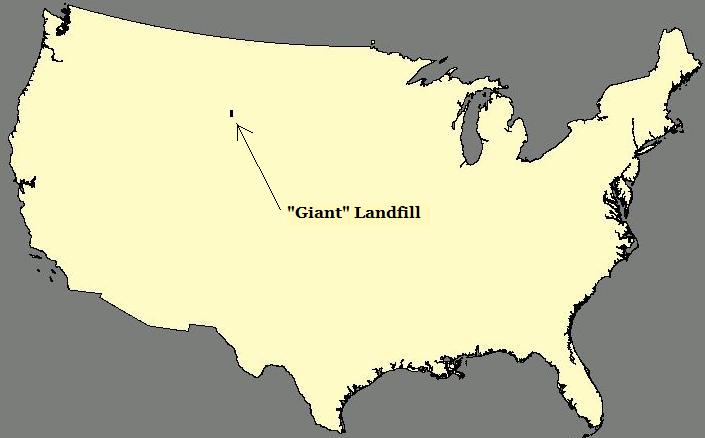
With all our trash in the Dakotas, as it should be.
Maybe this makes sense to New Yorkers -- their state did birth the "trash crisis" myth which has followed American politics home like a stinky dog. However, recycling has remained a national craze, even though landfills are generally cheap and available across the country. Fun fact: If all American trash were brought to one huge landfill, and "you keep filling up this landfill for 100 years, and if you assume that during this time the populations of the United States doubles, then the landfill will cover about 160,000 acres, or 250 or so square miles, with trash 400 feet deep." Source. That may seem like a lot, so to put it in perspective, see the attached diagram which compares the 3,717,813 square miles of the lower 48 to this hypothetical landfill. Doesn't look so big now, does it?

Recycling colored glass, paper and plastic isn't just unnecessary; it's also inefficient. Let's count the ways:

Monday, July 26, 2010

Krugman on "Greed and Cowardice" in the climate debate

Was Paul Krugman famous for his work in economics, or was it environmental studies? Right now, I'm not sure. From an op-ed article yesterday:
It has always been funny, in a gallows humor sort of way, to watch conservatives who laud the limitless power and flexibility of markets turn around and insist that the economy would collapse if we were to put a price on carbon.
Source. An intelligent person like Mr. Krugman can spot a bad argument, especially when it applies to his home discipline of economics. The passage above contains logical flaws which should have stood out to a Nobel Laureate.

- "Putting a price on carbon" is a bit more complicated than grabbing the sticker gun and tagging away like a manic grocery store employee.