Showing posts with label salaries. Show all posts

Monday, June 4, 2012

Paycheck Fairness Act is anti-womens' employment

Scheduled to come to a vote in Congress tomorrow, the Paycheck Fairness Act is a bad solution to a statistically trumped-up problem.

The most frequently cited statistic is that women earn 77 cents for every dollar a man makes. However, not all of that gap can be attributed to discrimination.

The Bureau of Labor Statistics reports that comparing male and female full-time workers, men work more hours: 8.2 versus 7.8 hours per day, on average. Just assuming an exactly even hourly rate, we'd expect women to earn 95% of men's total on a yearly basis; however, there are also more women working part-time than men, widening the gap further. Men are also disproportionately likely to die from an injury on the job, as this chart shows.

Source: US Department of Labor, Bureau of Labor Statistics, Current Population Survey, and Census of Fatal Occupational Injuries, 2012.
But put aside those statistical details. A gap in male-female wages undoubtedly remains, and some of it is probably due to gender-bias and discrimination. What does the Paycheck Fairness Act do to fix that?

The Act would strengthen the Equal Pay Act of 1963, which already requires similar workers be paid the same. The new legislation would expand the damages that women can claim in court, and give women more tools to sue their employers if discrimination is suspected.

The new law would result in effectively unlimited liability for a business sued for giving unequal pay. Put yourself in the shoes of a small business owner. Suppose you are considering hiring either a male or female employee for an entry-level position. Suddenly knowing that your business could be shut down if a court decides your payment to the woman is unfair, who would you be more inclined to hire?

Let's think of another group that has been "protected" by sweeping federal legislation. Persons with physical disabilities are given additional tort resources by the Americans with Disabilities Act if it's found that they were treated unfairly. A paper by Acemoglu and Angrist (2001), using reliable econometric techniques, found that employment of disabled people dropped substantially following the ADA's passage. Now, twenty years later, physically disabled persons are unemployed at record levels.

There are obvious weaknesses in the analogy between the Paycheck Fairness Act and Americans with Disabilities Act - women are a larger segment of the population, and aren't physically limited from doing most jobs - but a lesson remains. Creating new protected classes of workers is not always to that group's overall benefit.

Even well-intentioned laws may end up punishing businesses for hiring certain workers, which hurts both individuals and the economy as a whole. The Paycheck Fairness Act is almost certainly dead in the water; even without passage, its political purpose will have been achieved. But, if President Obama and the Democrats want to show they are helping women, a first step is to not shut them out of the labor market.

Sunday, February 5, 2012

The value of flexible labor markets

Three stories in the news today highlight the importance of labor market mobility.

The United States has had some good news lately. With job spurt, US economy races ahead of Europe:
Some 1.9 million US jobs have been created in the past five months, bringing the number of people working nearly back to the levels of late 2008.
Jacob Kirkegaard, economist at the Peterson Institute for International Economics, said the latest developments in the labor market show the resilience of the US economic model.
"When you're a US employer, you barely hesitate to hire because you know if you take a worker for a peak in business, you can easily lay off that person if it doesn't turn out as planned," he said.
"In Italy, in Spain, in France, in Greece, the costs for that are high." 
Those high costs are creating problems in Greece. Employed But Not Paid, Some Greeks Voice Protest:
If ALTER TV laid off these workers, the owner would have to pay millions in compensation. Under Greek law, white-collar workers, for example, with 24 years on the job are entitled to 28 months of severance pay.
These days, few employers can afford that, says Vassilis Masselos, a shop owner who has been pressing the government on business reforms.
"It's not a matter of choice, it's a matter of necessity," Masselos says. "They can't find the money to pay employees. They cannot fire them. So they are locked into a sort of limbo that nobody can get out of."
Inflexible labor markets make economic contractions worse, and also slow the pace of recovery. Meanwhile, Canada is offering visas to Indian professionals as their economy improves. Human capital is the largest resource in any economy, so allowing movement toward higher-valued uses is essential for productivity and growth.

Thursday, February 2, 2012

Productivity is bad for job growth?

Scanning the news feed for something worthy of being shared with Twitter, I happened across this good news/bad news article from USA Today: Unemployment benefit claims, worker productivity fall. Less benefit claims is a sign that more people are going back to work, although drops in productivity temper optimism about the speed of economic recovery.

Instead, apparently the author of this piece took it be good news/good news, claiming
Weaker productivity growth can help boost hiring if economic growth picks up.
This argument is motivated by the lump of labor fallacy (the idea that there are only so many jobs to be done, so higher productivity will leave more out of work) and a preoccupation with firms as purveyors of jobs rather than producers of products. Both of these ideas are largely discredited among economists.

In reality, productivity growth is the driving factor behind economic expansion. For economic growth to pick up, we need the inputs of production (labor, capital, etc.) to become more productive, not slow down! This allows us to both become richer and create more jobs as a society.

At the micro-level, theory predicts that a firm will not pay a worker more than their marginal product; i.e. if a machinist can produce $50 worth of goods in an hour, a company that pays him/her $51 per hour will be losing money. USA Today misses the irony when going on to claim
consumers have been weighed down by wages that haven't kept pace with inflation.
If that is occurring, it's because worker productivity hasn't kept pace with other factors in the economy. This argument is made in more detail by several recent books: Race Against the Machine by Erik Brynjolfsson and Andrew McAfee, and The Great Stagnation by Tyler Cowen both explore the phenomenon of declining worker productivity, and neither are excited about that decline as a source of new jobs.

Lower productivity means reduced living standards for future Americans. It doesn't even rise to the level of a placebo for our current unemployment woes; generally, placebos are expected to do nothing, not make the problem worse.

Thursday, January 12, 2012

Liberal Arts Degrees as Social Signaling

The model of education as signaling for the labor marketing has been thoroughly developed by Bryan Caplan; for some examples, see here, here, and here. I think the argument is pretty convincing, but it leaves a few details unexplained. Namely, some majors - especially liberal arts - are not even very good as signals!

The highest unemployment rates for college graduates are found among architecture, art, and humanities majors. Especially given the relatively low salaries for jobs in these "industries" why go into serious debt to get a degree, when the signal is likely to be weak or even totally ineffective? While the number of liberal arts colleges has been declining over the last 20 years and business is the most popular major for under-graduates (chosen by 20% of students) the liberal arts curriculum is far from disappearing.

It could be that these students are maximizing with regard to something other than wealth, such as social status. This may accrue to either the college student or that student's parents, who get to brag about how their son/daughter will be a progressive hero and "save the world one day." Parents have incomplete control over what major their child picks, but at least some power to encourage or discourage certain fields of study.

Thinking of education as a status symbol helps to explain variation in choice of majors across countries. In the United States, the poor and middle-class can get luxury items like fancy cars, jewelry, nice TVs, smartphones etc. by using credit (Robert Kiyosaki's "Rich Dad Poor Dad" observes that this is a big reason why they do not ascend to the capitalist upper-class). Seeing someone with nice jewelry or the latest tech is no longer a good indicator of high status in America; in fact, it is often a signal of the opposite! A liberal arts degree then becomes a new status symbol, a way of displaying "yes I can spend four years doing nothing productive, and rack up debts while doing it, because money isn't important to me."

In China, by comparison, most of the affluent or middle-class people have attained that status within the last one or two generations. The rich in China display their wealth through luxury items, but parents still often discourage or frown upon liberal arts degrees (or so I'm told by someone with personal experience). Based on the social signaling theory sketched out above, one would expect that as the middle-class in China grows and expensive items are no longer limited to the nouveau riche, more will go get liberal arts degrees, instead of the focus on STEM (science, technology, engineering, and math) which is the stereotypical image of Chinese students currently.

If this model is accurate, it just further reinforces Dr. Caplan's point that we should not be subsidizing higher education as much as we are now.

Saturday, December 24, 2011

Fuzzy Economics and Legal Fees

The New York Times has published several articles in the last two months targeting the American Bar Association. In October, Clifford Winston questioned the need for bar exams and professional licensing. Last week, David Segal wrote "For Law Schools, a Price to Play the A.B.A.’s Way" which blames the ABA's control over law school accreditation for overly high legal fees.In that article, he writes
...The lack of affordable law school options, scholars say, helps explain why so many Americans don’t hire lawyers.

“People like to say there are too many lawyers,” says Prof. Andrew Morriss of the University of Alabama School of Law. “There are too many lawyers who charge $300 an hour. There aren’t too many lawyers who will handle a divorce at a reasonable rate, or handle a bankruptcy at a reasonable rate. But there is no way to be that lawyer and service $150,000 worth of debt.”

This helps explain a paradox: the United States churns out roughly 45,000 lawyers a year, but survey after survey finds enormous unmet need for legal services, particularly in low- and middle-income communities...
This reasoning doesn't make sense to me. It may be true that lawyers are driven to make more money in order to pay off student loans. But, high fees are not the only way to make lots of cash; there is also the low-cost, high-volume strategy (think Walmart). If so much unmet demand for legal services exists, it could be more profitable to charge a lower hourly rate and just work faster or put a little less effort into each case. This wouldn't be practical if the supply of lawyers is artificially restricted, but given the 45,000 new lawyers every year as well as reportedly high numbers of unemployed or idle lawyers, a shortage seems to be unlikely.

Even if the ABA does drive up the cost of law school tuition, that alone can't explain why legal fees are so high. I'd hypothesize that clients pay lawyers a premium wage in order to ensure a high level of effort. As it is hard to monitor an attorney's effort directly, better wages are used as an incentive to keep on the job instead of slacking. In the economics literature, this is referred to as an efficiency wage; the concept has been used to explain why wages remain rigid during periods of high unemployment. That seems to apply quite easily to the legal industry.

I'm sympathetic to the argument for lowering entry barriers to practicing law, but there are other factors at work too which cause lawyer wages to be high. Otherwise, competition in the legal industry would have already driven down prices and serviced the unmet needs in low- and middle-income communities.

Wednesday, July 28, 2010

If Bernie Madoff had a hobby... an exploration of D.O.D. accounting practices

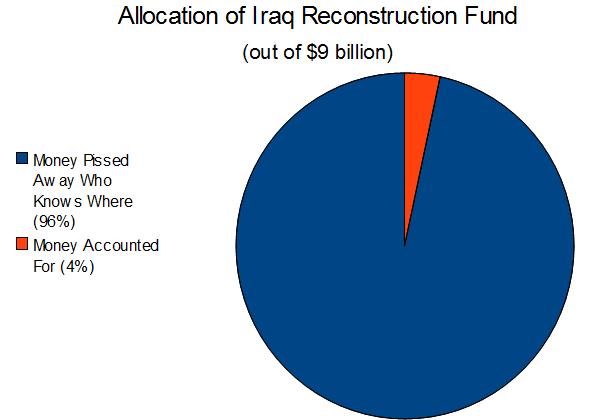
In the news: Special Inspector General for Iraq Reconstruction says that 96% of the money from the Development Fund for Iraq cannot be accounted for. This is very different, and probably worse, than saying those funds were ineffective. Based on press releases, the Department of Defense just hasn't a clue where the money went. To further illustrate the situation, see the attached pie chart.

No one has ever accused the military of being efficient, but even with the infamous $640 toilet seat we at least knew where the money went. If there's one thing a giant bureaucracy like the D.O.D. should be good at, it's keeping paperwork. Those times seem to have changed since the Bush presidency and Iraq invasion.  

So where did those 8.7 billion dollars go? As a personal guess, we'll probably find Jimmy Hoffa before those funds are fully accounted for. However, based on the record so far, it's likely that money was eaten up by the fraud, bribery and theft which has plagued reconstruction efforts from the start. How did this problem begin?